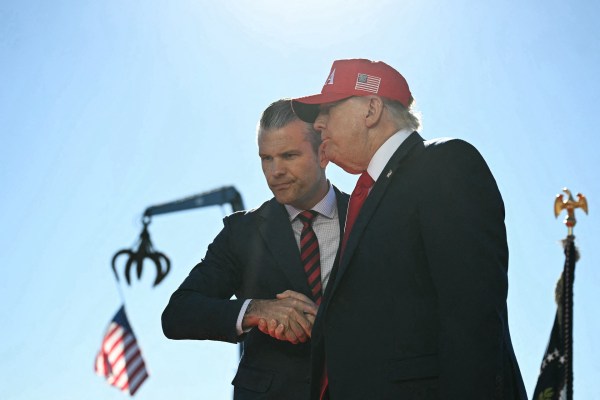
US President Donald Trump (R) shakes hands with Secretary of Defense Pete Hegseth as he arrives to speak at Anduril Industries in Sparrows Point, Maryland, on October 6, 2026. (Photo by Jim WATSON / AFP via Getty Images)
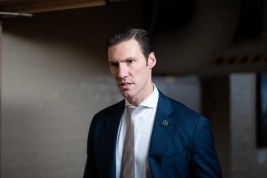
UNITED STATES – DECEMBER 10: Rep. Pat Harrigan, R-N.C., arrives for the House Republican Conference meeting in the U.S. Capitol on Wednesday, December 10, 2025. (Bill Clark/CQ-Roll Call, Inc via Getty Images)
From left to right, Google Public Sector CEO Karen Dahut speaks with GSA Administrator Ed Forst, DOD Undersecretary for Acquisition and Sustainment Michael Duffey and Google Cloud CEO Thomas Kurian at the Google Public Sector Summit on Oct. 20, 2026 in the Ronald Reagan Building and International Trade Center in Washington, D.C.
U.S. Marine Corps Lt. Gen. Eric E. Austin, the commanding general of Marine Corps Combat Development Command and deputy commandant for Combat Development and Integration, Portfolio Acquisition Executive, Marine Corps, provides his remarks at the Mavin Smart System Summit at Quantico Corporate Center, Va., Aug. 25, 2026. (U.S. Marine Corps photo by Lance Cpl. Magdalena Tochimani-Fuentes)
New research from VisionHeight highlights how AI systems can often serve as more useful marks for influence actors than humans. To wit: someone is setting up networks of hyperlocal websites across at least 14 different states, filled with content meant to influence U.S. races. (Image via Getty)
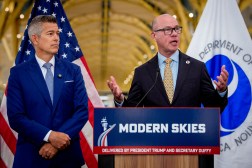
FAA Administrator Bryan Bedford, right, and Transportation Secretary Sean Duffy, left, speak during a news conference at Ronald Reagan Washington National Airport on Sept. 28, 2026 in Arlington, Va. (Photo by Andrew Harnik/Getty Images)
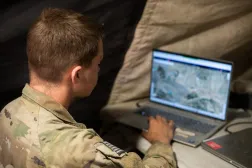
U.S. Army 2nd Lt. Kyle A. Frakes, assigned to 4th Squadron, 10th Cavalry Regiment, 1st Armored Brigade Combat Team, 4th Infantry Division, operates the ADIP software platform during a division reconnaissance and security experiment as part of Project Convergence Capstone 6 at Fort Irwin, California, July 21, 2026. (U.S. Army photo by Staff Sgt. Ger’vonni Straun)
WASHINGTON, DC – SEPTEMBER 29: (L-R) U.S. Director of National Intelligence Jay Clayton, CEO of Meta Platforms Mark Zuckerberg, Co-Founder at Anthropic Tom Brown, U.S. President Donald Trump and David O. Sacks hold a press briefing with AI executives following a meeting on artificial intelligence, outside the West Wing of the White House on September 29, 2026 in Washington, DC. The meeting comes as some have called for a slowdown in AI development amid rising safety concerns. (Photo by Kevin Dietsch/Getty Images)
Jennifer Franks, director of the GAO’s Center for Enhanced Cybersecurity, speaks during the Elastic Public Sector Summit on March 19, 2026, in Washington, D.C. (Scoop News Group photo)
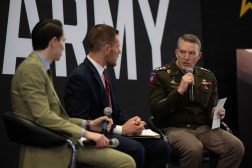
Lt. Gen. Chris Eubank, Commanding General, United States Army Cyber Command, speaks at the Warriors Corner #3 during the 2026 Association of the United States Army (AUSA) Annual Meeting and Exposition at the Walter E. Washington Convention Center in Washington, D.C., Oct. 12, 2026. (U.S. Army photo by Rey Ramon)
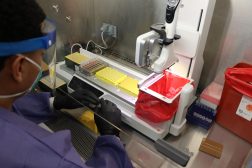
A laboratory technician at the Synthetic Biology and Biosurveillance Branch at the U.S. Army Medical Research Institute of Infectious Diseases demonstrates the Biodefense Mass Sequencing and Surveillance assay, developed by a team of researchers under the direction of branch chief Lt. Col. Jeffrey Kugelman during the coronavirus pandemic as a way to rapidly test large numbers of Service Members for exposure to COVID-19. BMASS can be used to test for multiple diseases at the same time, extending its potential beyond just COVID-19 surveillance. (DOD photo by: Paul Lagasse)