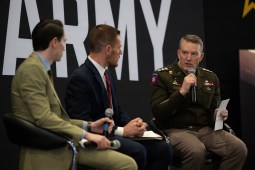
Lt. Gen. Chris Eubank, Commanding General, United States Army Cyber Command, speaks at the Warriors Corner #3 during the 2026 Association of the United States Army (AUSA) Annual Meeting and Exposition at the Walter E. Washington Convention Center in Washington, D.C., Oct. 12, 2026. (U.S. Army photo by Rey Ramon)
Task Force Lexington has “mapped out” an entire Cyber Protection Team composed of agents, including for analytic support and network analysts, among other roles.
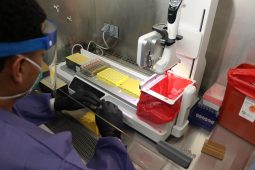
A laboratory technician at the Synthetic Biology and Biosurveillance Branch at the U.S. Army Medical Research Institute of Infectious Diseases demonstrates the Biodefense Mass Sequencing and Surveillance assay, developed by a team of researchers under the direction of branch chief Lt. Col. Jeffrey Kugelman during the coronavirus pandemic as a way to rapidly test large numbers of Service Members for exposure to COVID-19. BMASS can be used to test for multiple diseases at the same time, extending its potential beyond just COVID-19 surveillance. (DOD photo by: Paul Lagasse)
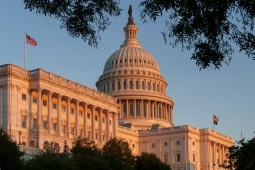
The setting sun casts a warm glow on the Senate side of the west front of the U.S. Capitol Building on September 14, 2026, in Washington, DC. (Photo by J. David Ake/Getty Images)
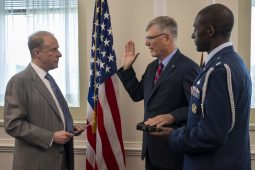
Deputy Secretary of Defense Steve Feinberg administers the oath of office to Secretary of the Air Force Troy Meink at the Pentagon, Washington, D.C., May 16, 2025. (Photo by U.S. Air Force Senior Airman Madelyn Keech)
The memo framed the Pentagon’s use of AI as a way to shed “dysfunction” caused by outdated classification and declassification procedures, which it describes as “endangering” to…
An aerial view of the National Mall, including the Washington Monument, the U.S. Capitol, the Jefferson Memorial, the Tidal Basin and the Pentagon from Air Force One as it departs on September 26, 2026 in Joint Base Andrews, Maryland. (Photo by Tom Brenner/Getty Images)
Microsoft Copilot illustrates how AI agents, built within commonly used, pre-approved and secure defense environments, can boost employee productivity.
U.S. Soldiers assigned to 3rd Squadron, 2nd Cavalry Regiment practice target lock-on against an incoming drone during Project Flytrap at Joint Multinational Readiness Center, Hohenfels Training Area, Hohenfels, Germany, June 9, 2025. (U.S. Army photo by Spc. Elijah Magaña)
Delivered through the service’s Digital Capabilities Contracting Center of Excellence (DC3oE), the award allows select Army organizations to use Kaizen’s application layer system, one meant to streamline…
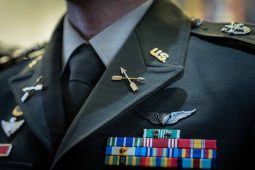
A 390A graduate dons their new Special Forces regimental distinctive insignia following the Activation and Induction ceremony at the U.S. Army John F. Kennedy Special Warfare Center and School, the Special Operations Center of Excellence, at the JFK Auditorium on Fort Bragg, N.C., Oct. 2, 2026. (U.S. Army photo by Sgt. 1st Class Alexis Washburn)
Ten warrant officers graduated from the Robotics Technician Integrator (390A) course in a ceremony at Fort Bragg, North Carolina on Friday, marking the official start of the…